
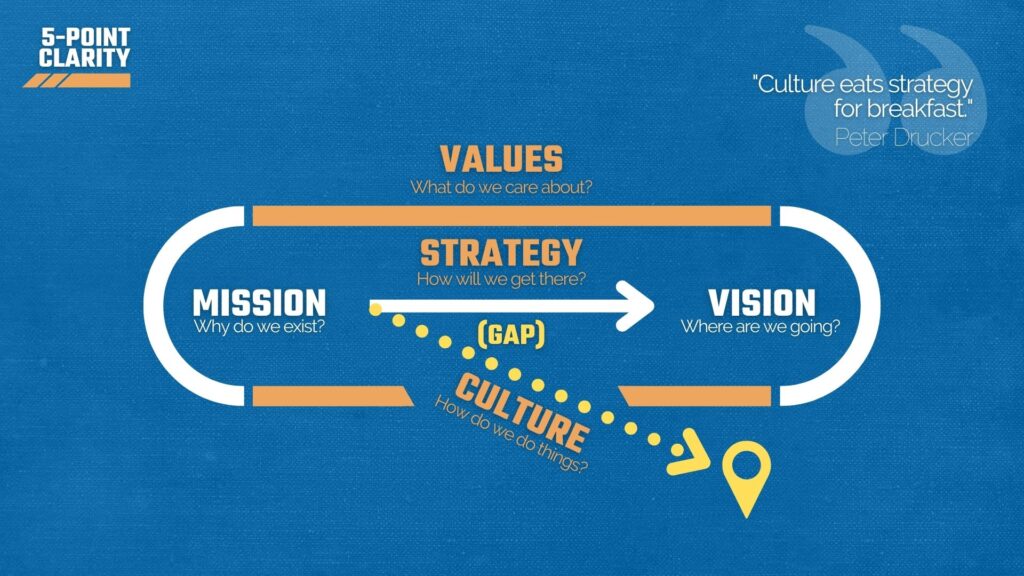
Every great team wants clarity. You can feel the difference when a team knows exactly who they are, where they’re going, and how they’re going to get there. People pull in the same direction. Conflict becomes productive. Accountability feels normal instead of threatening. And the mission actually advances.
But clarity doesn’t happen automatically. It requires leaders to slow down and systematically work through five core components—values, mission, vision, strategy, and culture—and then repeat those answers until the entire team can articulate them.
This article walks your leaders through a simple but powerful framework for organizational clarity, starting where clarity truly begins: your values.
1. Values: What Do We Care About Most?
Values answer the question, “What do we care about?”
Before you define mission or vision, you must define the non-negotiable behaviors and beliefs that shape how your team operates. Values set the tone for decision-making, communication, conflict resolution, and teamwork.
Most teams assume their values are obvious. They’re not. If you’ve never named them, clarified them, and reinforced them, people will fill in the blanks with their own personal preferences.
Clear values:
- Shape who you hire, coach, promote, and release
- Establish the expected behaviors for daily work
- Help everyone know how to act even when no one is watching
- Provide the guardrails for how your mission is lived out
Strong values aren’t aspirational—they describe what must be true in real life, not just in your branding.
Leadership tip: Choose 3–7 values, name them in simple language, and write one sentence explaining what each value looks like in action on your team.
2. Mission: Why Do We Exist?
Once your values provide the relational foundation, your mission defines the organizational purpose.
Mission answers the question, “Why do we exist?” It explains your team’s core job and the overarching contribution you’re trying to make. A mission statement should be simple, memorable, and inspiring.
A good mission statement:
- Acts like a compass, preventing drift
- Clarifies the ultimate purpose behind your work
- Helps teams decide what not to do
- Unifies people around meaning, not just tasks
When mission is unclear, teams lose focus. When mission is clear, teams gain energy and direction.
Leadership tip: Ask your top leaders to write their best one-sentence summary of why the team exists. If the answers differ, that’s a mission-clarity problem worth solving immediately.
3. Vision: Where Are We Going?
If mission provides purpose, vision provides the picture.
Vision answers the question, “Where are we going?” It describes a preferred future—what success looks like three, five, or ten years from now. Vision gives your people something to aim toward, not just something to work on.
Vision should be:
- Specific enough to imagine
- Inspiring enough to motivate
- Future-oriented but grounded in reality
Without vision, teams stay busy without moving forward. With vision, teams see how their daily work contributes to something bigger.
Leadership tip: Write a “future snapshot” that begins with: “Three years from now our team is…” Describe it in concrete, observable terms.
4. Strategy: How Will We Get There?
Once you know who you are (values), why you exist (mission), and where you’re heading (vision), the next question is “How will we get there?”
Strategy is the bridge between vision and daily execution. It identifies the big-ticket objectives—the major moves that will drive progress. Each strategic objective is broken into smaller, actionable steps so people know what to actually do each week.
Healthy strategy:
- Creates focus (3–5 priorities, not 20)
- Helps leaders sequence their efforts
- Filters out distractions, even “good” ones
- Provides measurable progress markers
Strategic clarity prevents “busy without impact” syndrome.
Leadership tip: Identify your top 3–5 strategic priorities for the next 12 months. If your list has 12 items, you don’t have a strategy—just a wish list.
5. Culture: Are We Doing What We Said We’d Do?
Here’s where everything rises or falls.
Culture answers the question, “How do we actually operate day-to-day—and does it match what we say we value and intend to do?”
Culture is not your posters, slogans, or onboarding documents. Culture is about accountability to your strategic objectives. It’s the lived reality of your habits, pace, communication norms, leadership behaviors, and decision-making.
This is where the concept of the culture gap becomes essential.
The Culture Gap: The Distance Between What You SAY and What You DO
Every organization has a gap between:
- Stated values and lived values
- Stated strategy and actual behavior
- Stated priorities and where time actually goes
This culture gap is the difference between your strategic objectives on paper and your real daily habits.
Examples of a culture gap:
- You say collaboration matters, but people work in silos.
- You say the priority is leadership development, but no one’s calendar reflects it.
- You say data matters, but decisions are made on gut instinct.
- You say excellence is important, but deadlines slip regularly.
Closing the culture gap requires:
- Honest assessment
- Clear accountability
- Consistent reinforcement
- Leaders modeling the behaviors they expect
Culture is the scoreboard of leadership. If your culture doesn’t reflect your strategy, your strategy will never become reality.
Leadership tip: Ask, “If an outsider tracked our calendars, conversations, and decisions for 30 days, what would they conclude our real strategy is?” That answer reveals the size of your culture gap.
Bringing the 5 Points Together
Use this framework with your leadership team:
- Define your values (relational clarity).
- Clarify your mission (purpose clarity).
- Paint your vision (future clarity).
- Identify your strategic objectives (execution clarity).
- Evaluate your culture and culture gap (accountability clarity).
Clarity cascades—from leaders to teams to daily habits. When a team aligns values, mission, vision, strategy, and culture, the entire organization becomes healthier, more focused, and more effective.
- Values: Which values currently shape your team the most—spoken or unspoken—and what values do you need to reinforce or redefine?
- Mission: How aligned are your top leaders when asked, “Why do we exist?” What drift do you need to correct?
- Vision: If you could snap a photo of your ideal team three years from now, what would be happening in that picture?
- Strategy: Which current projects truly support your strategic objectives, and which ones might be stealing focus?
- Culture Gap: Where is the biggest discrepancy between what your team says it is pursuing and what your team actually does each week?
- Accountability: What systems or habits could help close the culture gap and keep your strategic objectives from being forgotten in the daily grind?
- Leadership Modeling: What one behavior do you need to model more consistently to move your culture closer to your stated values and strategy?
Ready to bring 5-point clarity to your team? Schedule a consulatation.