
5-Point Clarity for the Team
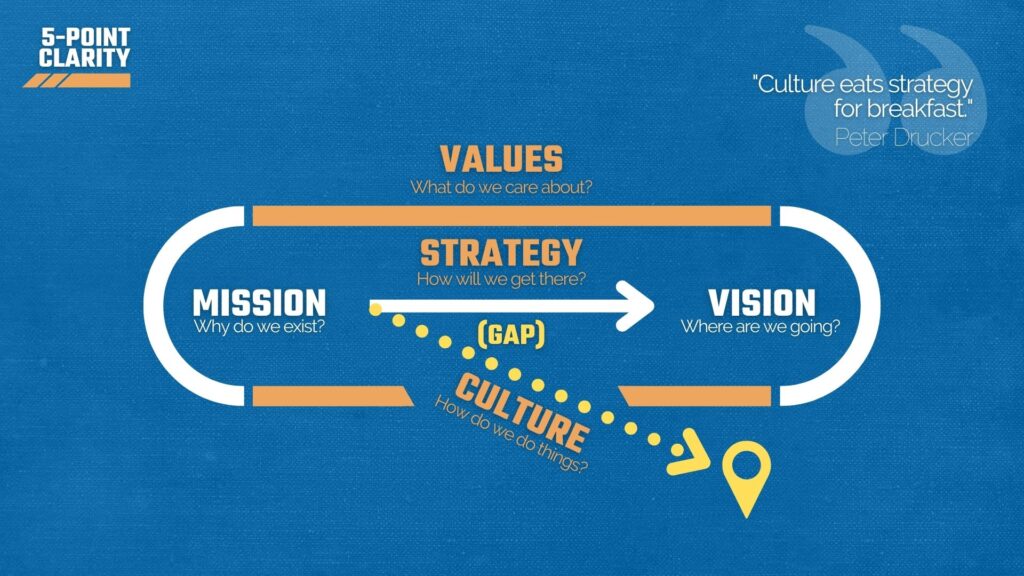
Every great team wants clarity. You can feel the difference when a team knows exactly who they are, where they’re going, and how they’re going to get there. People pull in the same direction. Conflict becomes productive. Accountability feels normal instead of threatening. And the mission actually advances.
But clarity doesn’t happen automatically. It requires leaders to slow down and systematically work through five core components—values, mission, vision, strategy, and culture—and then repeat those answers until the entire team can articulate them.
This article walks your leaders through a simple but powerful framework for organizational clarity, starting where clarity truly begins: your values.
1. Values: What Do We Care About Most?
Values answer the question, “What do we care about?”
Before you define mission or vision, you must define the non-negotiable behaviors and beliefs that shape how your team operates. Values set the tone for decision-making, communication, conflict resolution, and teamwork.
Most teams assume their values are obvious. They’re not. If you’ve never named them, clarified them, and reinforced them, people will fill in the blanks with their own personal preferences.
Clear values:
- Shape who you hire, coach, promote, and release
- Establish the expected behaviors for daily work
- Help everyone know how to act even when no one is watching
- Provide the guardrails for how your mission is lived out
Strong values aren’t aspirational—they describe what must be true in real life, not just in your branding.
Leadership tip: Choose 3–7 values, name them in simple language, and write one sentence explaining what each value looks like in action on your team.
2. Mission: Why Do We Exist?
Once your values provide the relational foundation, your mission defines the organizational purpose.
Mission answers the question, “Why do we exist?” It explains your team’s core job and the overarching contribution you’re trying to make. A mission statement should be simple, memorable, and inspiring.
A good mission statement:
- Acts like a compass, preventing drift
- Clarifies the ultimate purpose behind your work
- Helps teams decide what not to do
- Unifies people around meaning, not just tasks
When mission is unclear, teams lose focus. When mission is clear, teams gain energy and direction.
Leadership tip: Ask your top leaders to write their best one-sentence summary of why the team exists. If the answers differ, that’s a mission-clarity problem worth solving immediately.
3. Vision: Where Are We Going?
If mission provides purpose, vision provides the picture.
Vision answers the question, “Where are we going?” It describes a preferred future—what success looks like three, five, or ten years from now. Vision gives your people something to aim toward, not just something to work on.
Vision should be:
- Specific enough to imagine
- Inspiring enough to motivate
- Future-oriented but grounded in reality
Without vision, teams stay busy without moving forward. With vision, teams see how their daily work contributes to something bigger.
Leadership tip: Write a “future snapshot” that begins with: “Three years from now our team is…” Describe it in concrete, observable terms.
4. Strategy: How Will We Get There?
Once you know who you are (values), why you exist (mission), and where you’re heading (vision), the next question is “How will we get there?”
Strategy is the bridge between vision and daily execution. It identifies the big-ticket objectives—the major moves that will drive progress. Each strategic objective is broken into smaller, actionable steps so people know what to actually do each week.
Healthy strategy:
- Creates focus (3–5 priorities, not 20)
- Helps leaders sequence their efforts
- Filters out distractions, even “good” ones
- Provides measurable progress markers
Strategic clarity prevents “busy without impact” syndrome.
Leadership tip: Identify your top 3–5 strategic priorities for the next 12 months. If your list has 12 items, you don’t have a strategy—just a wish list.
5. Culture: Are We Doing What We Said We’d Do?
Here’s where everything rises or falls.
Culture answers the question, “How do we actually operate day-to-day—and does it match what we say we value and intend to do?”
Culture is not your posters, slogans, or onboarding documents. Culture is about accountability to your strategic objectives. It’s the lived reality of your habits, pace, communication norms, leadership behaviors, and decision-making.
This is where the concept of the culture gap becomes essential.
The Culture Gap: The Distance Between What You SAY and What You DO
Every organization has a gap between:
- Stated values and lived values
- Stated strategy and actual behavior
- Stated priorities and where time actually goes
This culture gap is the difference between your strategic objectives on paper and your real daily habits.
Examples of a culture gap:
- You say collaboration matters, but people work in silos.
- You say the priority is leadership development, but no one’s calendar reflects it.
- You say data matters, but decisions are made on gut instinct.
- You say excellence is important, but deadlines slip regularly.
Closing the culture gap requires:
- Honest assessment
- Clear accountability
- Consistent reinforcement
- Leaders modeling the behaviors they expect
Culture is the scoreboard of leadership. If your culture doesn’t reflect your strategy, your strategy will never become reality.
Leadership tip: Ask, “If an outsider tracked our calendars, conversations, and decisions for 30 days, what would they conclude our real strategy is?” That answer reveals the size of your culture gap.
Bringing the 5 Points Together
Use this framework with your leadership team:
- Define your values (relational clarity).
- Clarify your mission (purpose clarity).
- Paint your vision (future clarity).
- Identify your strategic objectives (execution clarity).
- Evaluate your culture and culture gap (accountability clarity).
Clarity cascades—from leaders to teams to daily habits. When a team aligns values, mission, vision, strategy, and culture, the entire organization becomes healthier, more focused, and more effective.
- Values: Which values currently shape your team the most—spoken or unspoken—and what values do you need to reinforce or redefine?
- Mission: How aligned are your top leaders when asked, “Why do we exist?” What drift do you need to correct?
- Vision: If you could snap a photo of your ideal team three years from now, what would be happening in that picture?
- Strategy: Which current projects truly support your strategic objectives, and which ones might be stealing focus?
- Culture Gap: Where is the biggest discrepancy between what your team says it is pursuing and what your team actually does each week?
- Accountability: What systems or habits could help close the culture gap and keep your strategic objectives from being forgotten in the daily grind?
- Leadership Modeling: What one behavior do you need to model more consistently to move your culture closer to your stated values and strategy?
Ready to bring 5-point clarity to your team? Schedule a consulatation.
5-Star Leadership Assessment
Talking Points:
- Credibility: Do you live out the values of the organization, or do secretly believe they don’t apply to you?
- Conviction: Do you really buy in to the mission of the organization, or are you just giving it lip service?
- Clarity: Are you clear on the vision and strategy of your organization, or are you just making it up as you go?
- Candor: Are you willing to be honest with yourself and others when the mission isn’t being accomplished?
- Candor: Are you building relationships as you work together, or is your team just a means to an end for you?
- Initial reactions to this topic? What jumped out at you?
- Name a great leader in your life. What makes him or her great?
- Answer the questions in the talking points above. Which star is your greatest strength? Which one needs the most work? Explain.
- Why is missional clarity important for a leader? What can happen to a team that is unclear on its bottom line?
- What are the signs that someone has a deep conviction about the team they are leading? How can you know when they’ve lost that conviction?
- Leaders who “fake it” are eventually exposed and deposed. Give an example of a leader who was not authentic. What happened to the leader and/or team?
- Write a personal action step based on this conversation.
5 Dysfunctions of a Team
Talking Points:
- Trust is the base for a functional team. If your team doesn’t trust each other they won’t be willing to work together to achieve the goals they’ve set. Lack of trust places your team into a cycle of dysfunction.
- Conflict is essential and can be productive in helping everyone voice an opinion. However, if the conflict in your team isn’t confronted correctly it can lead to dysfunction number three.
- When your team communication isn’t good it can lead to team member not committing to the decisions that are made. Reaching a consensus as a team isn’t really the end goal. The end goal is to have everyone voice their opinion.
- Lack of accountability is another way your team can fall apart. If members are defensive and can’t ownership for mistakes, it leads to further dysfunction.
- You need to have clarity on specific goals as a team. Make sure performance reports of team members are in line with the strategic objectives of your team.
- Initial reactions to this topic? What jumped out at you?
- Which of these five dysfunctions do you most commonly see within your team? How have those things impacted the team?
- Why is trust so important to a healthy functioning team? What happens when people get defensive about their mistakes? What happens when people are willing to own their mistakes?
- List some specific and practical ways you can combat these five dysfunctions.
- What are some other things, that aren’t on this list, that you have observed in your team that have had a negative effect on team performance? Other things that have had a positive effect?
- Is there a step you need to take based on today’s topic?
Adapted form Patrick Lencioni’s book The Five Dysfunctions of a Team
- Your Culture Gets What It Pays For
- Workplace Tips To Make Employees Comfortable
- Winning the War Within as a Leader
- Why Your Business Needs an Electronic Access Control System
- Why You Should Talk About Pay With Your Coworkers
- Why Transparency Is So Important In the Workplace
- Why Some Bosses Don’t Understand Individual Job Duties
- Why Entrepreneurs Should Implement Document Destruction
- Why Companies Are Investing in On-Site Massage Services
- Why Air Quality Matters in Shared Workspace
- Where Should A Commander Be On The Battlefield?
- What’s Your Mission at Work?
- What’s It Like Being a Black Man in Corporate America?
- What To Know When Starting a Career in Healthcare
- What To Expect During Training To Become a Private Pilot
- What To Consider Before a Career in Law Enforcement
- What it Means to Be a Leader
- What Is Team Culture (and Why Is It So Important)?
- What Google Learned about Team Culture
- Ways To Use Facebook to Your Business’s Advantage
- Values in Leadership
- Unlocking Your Potential: The Power of a Growth Mindset
- Unique Opportunities for Women in Male-Dominated Industries
- Turning Constraints into Opportunities: Small Space Design
- Trending Business Ideas You Should Know for 2025
- Top Ergonomic Office Tips for Long Work Hours
- Tips To Help Your Small Business Create a Budget
- Tips for Representing Your Company at an Event
- Tips for Better Communication
- Things To Consider Before Seeking a Career in IT
- The One Factor That Causes Depression in the Workplace
- The Four Types of Meetings in the Workplace
- The Five Dysfunctions of a Team
- The Eisenhower Priority Matrix for Leaders
- The Best Ways for Manufacturing Facilities To Save Money
- The Benefits of Obtaining a Crane Operator License
- The 7 Habits of Highly Effective People
- The 4 Things Bezos Looks for in a Quality Product
- The 3 C’s to Get Your Team on the Bus
- Technological Advancements Your Medical Practice Needs
- Strategy, Action Steps and Habits for the Team
- Strategic Alignment
- Stop Doing These 3 Things If You Want To Succeed
- Sparking Conversations About Electrical Safety at Work
- Shattering the Glass Ceiling for Women in the Workplace
- Set the Right Goals for Your Company and Adjust as You Go
- Scorecard for Strategic Planning
- Salary Negotiating Tips for Women
- Safety First: 5 Key Tasks for First Responders in the Field
- Reasons Your Small Business Should Use Apple Products
- Preparing for the Future of Work: AI in the Workplace
- Passive Aggressive Leaders Are Weak
- Next Level Work Ethic
- Modern Tech That’s Improving Safety in Law Enforcement
- Michael Jordan’s Top 10 Rules For Success
- Mastering the 7 Habits: Unlocking Your Potential for Success
- Maintaining the Edge as a Leader
- Lessons from Forestry: Working Smarter, Not Harder
- Leading Creative Teams Is Like Herding Tigers
- Leaders Eat Last: Why Some Teams Pull Together and Others Don’t
- Jeff Bezos’s Top 10 Rules For Success
- Interesting Life Science Careers Worth Exploring
- Important Tips for Pursuing a Career in Logistics
- How to Use Rhetoric to Get What You Want
- How To Transform Employees Into a High-Performing Team
- How To Train Your Team Without Overwhelming Them
- How to Take a Product Idea and Make It Real
- How to Stay Agile in Your Career
- How to Spread the Leadership Virus
- How to Repair Broken Trust on Your Team
- How To Reduce Costs and Spending in the Paint Industry
- How To Navigate Working in a High-Turnover Industry
- How to Motivate Underperformers
- How To Measure Success as an Investment Group
- How To Leverage Your Creativity in the Workplace
- How To Keep Your Team Motivated
- How To Identify Verbal Harassment in Your Workplace
- How to Hire the Right People
- How to Get Your Whole Team Motivated for Mission: Start with Why
- How To Create Accessible Workplaces for All Employees
- How To Choose a Career That’s Impactful to Your Life
- How to Build Trust and Loyalty With Your Salon Clients
- How To Balance Authority With Empathy as a Leader
- How The SBA Coronavirus Small Business Loans Work
- How the Right Office Space Can Impact Workplace Culture
- How EMF Radiation Affects Productivity in the Workplace
- How Being a Parent Prepares You for Leadership
- How a SWOT Analysis Can Help Your Team
- Handling Emotions In Conflict Resolution
- Handcrafted: Designing a Product to Scale
- Giving Healthy Feedback in the Workplace
- Getting to the Root of the Problems on Your Team
- Getting the Right People on the Bus
- Get Your Resume To Stand Out With These Strategies
- Get On “The Energy Bus”
- Essential Tips To Foster Connection in Your Workplace
- Emotional Intelligence at Work: Why IQ Isn’t Everything
- Emotional Intelligence and the Fundamental Law of Leadership
- Emotional Intelligence (EQ) Fighter Pilot Style
- Eliminating Sideways Energy
- Doing Conflict for the Good of Everyone
- Dare to Lead by Brené Brown
- Creative Ways to Boost Team Productivity in the Office
- Common Mistakes To Avoid When Working in a Cleanroom
- Coach Wooden’s Definition of Success
- Business Advice From the Best and Brightest
- Budgeting Tips for Planning a Small Business Event
- Budgeting Basics for Starting a Medical Practice
- Bringing Sustainability to the Table at Work Meetings
- Being Vulnerable as a Leader
- Banking on the Edge: Inside the Silicon Valley Bank Failure
- Ask a Manager: Your Ultimate Guide to Navigating the Workplace
- Applying Your EQ To Everyday Environments
- 9 Tips for Being a Better Leader
- 7 Ways To Motivate Your Team When Work Gets Tough
- 7 Signs You Are Going to Be Successful
- 6 Effective Strategies for Managing Workplace Conflict
- 5-Point Clarity for the Team
- 5 Ways to Know if You’re a Great Leader
- 5 Unique Ideas for Your Contracting Business
- 5 Tips That Will Make Your Resume More Appealing
- 5 Tips for Rescuing a Struggling Start-Up
- 5 Things Every Nonprofit Team Needs To Thrive
- 5 Steps To Get the Best Price for Your Private Practice
- 5 Reasons Why Video Conferencing Is So Exhausting
- 5 Key Considerations Construction Managers Must Make
- 5 Forgotten Things To Know Before Going Into Healthcare
- 5 Dysfunctions of a Team
- 4 Technology Habits That Could Be Harming Your Business
- 4 Strategies for Truck Drivers Trying To Advance in Their Careers
- 4 Signs of a Good Listener
- 4 Secrets to Standing Out in a Competitive Job Market
- 4 Safety Rules for Coring Concrete To Always Follow
- 4 Reasons Why Your Team Feels Misaligned at Work
- 4 Corner Training in 2 Minutes
- 4 Boundaries To Set if You Work in Hospitality
- 4 Benefits of Giving Corporate Gifts to Your Employees
- 3 Pillars Of a Healthy Leader In the Workplace